Showing posts with label Skunks. Show all posts

Saturday, June 11, 2022

The Trouble With Solutions


This week Boston news ran a story about how Medford residents are frustrated with the large number of rats (the picture was of a mouse) inhabiting their hamlet. Trust me Medford, when I post that I feel your angst.


Knowing practically nothing about Medford, I took a guess and commented that Medford didn't so much as have a rat problem as they had a shortage of predators problem. Suggesting that Medford increase their number of snakes, fox, weasel, raptor and coyote earned me more than a few laughing emojis. 


I had to concede that one solution does not fit all scenarios; and oddly enough other people who read the Boston news also had their own ideas on how to solve the infestation. In fact, several suggested domestic cats, like this new to my yard cat for example. While I imagine that our beloved neighborhood cat Tobie is none to pleased about this fluffy orange cat checking out his turf, Tobie clearly is not handling all of my rodent woes on his own.  If I'm to be honest however, I also must include to the list of cat solution conflicts, that it's estimated that outdoor cats kill between 30 to 48 birds per cat per year. That's 1.3 to 4 billion birds a year! (The Cornell Lab, All About Birds). 


I wondered if perhaps the solution didn't require a larger cat, one that didn't focus on birds so much? As it turns out, bobcats eat both birds and small rodents and a lot of other things; but mostly they prefer to dine on hair and rabbits. 
(bobcat) 
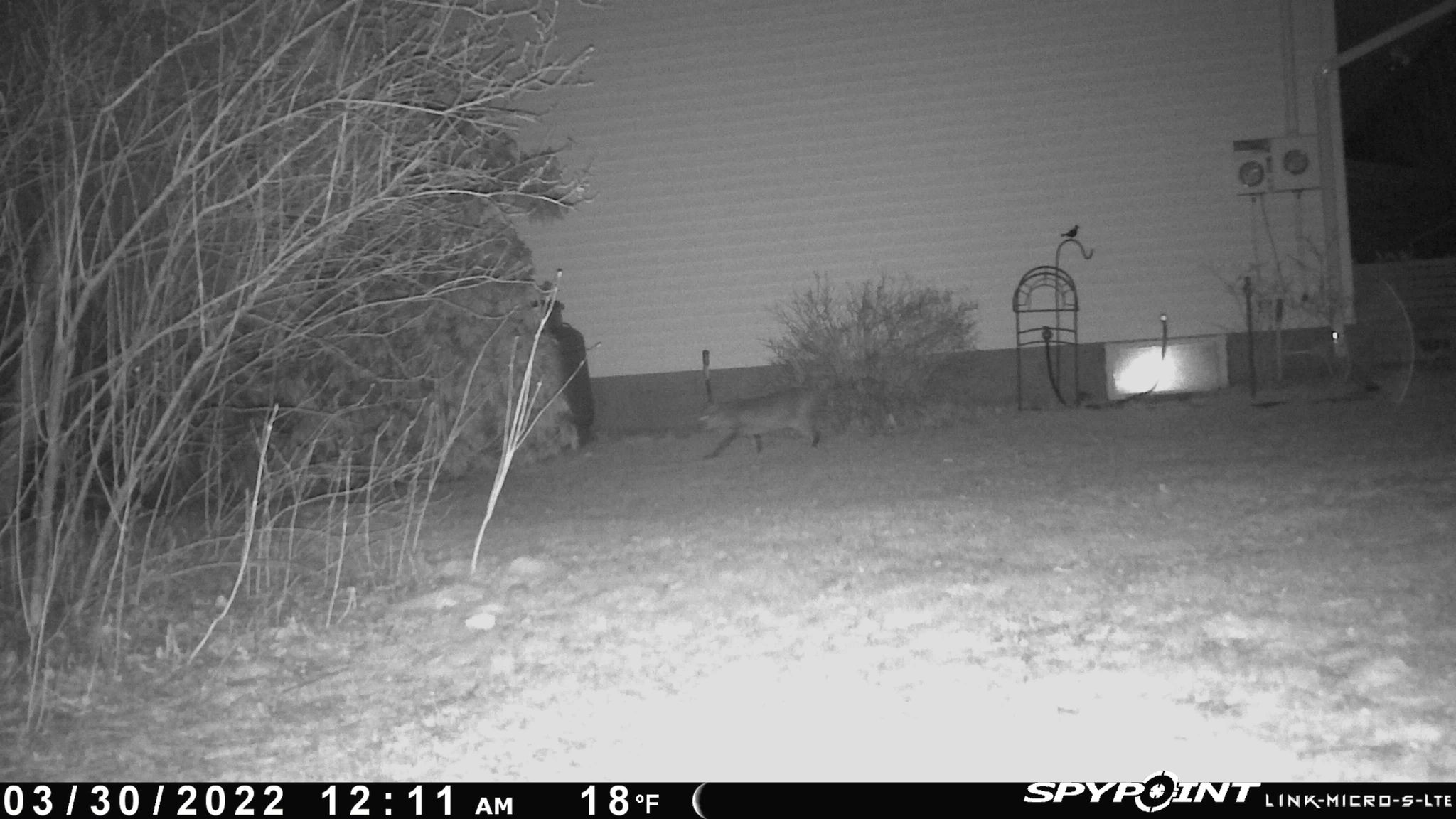
Perhaps it's time that I step out of the realm of Medford and check out something closer to home. There is currently quite the dustup over a certain gray fox wandering about in Saxtons River. It seems that residents are worried about the fox rambling about so close to houses during daylight hours. Some even suggesting that such behavior is odd for a fox and that it might in fact have rabies. One invested participant informed readers that they should stop composting for the time being as the fox was after their compost. I can imagine how she thought this as rodents do favor compost piles and fox favor eating rodents. 

All of this begs to question, what else do we get wrong? 


No, that's not a huge rat in my yard, it is an opossum. Feeling poorly for the Saxtons River fox, I attempted to defend its honor by explaining the tick / Lyme disease cycle and how mice are largely responsible for the transmission of bacterium Borrelia burgdorferi to ticks which in turn bite us causing Lyme disease. I know it's confusing because we call them deer ticks. Deer are poor transmitters however and they most often are just free transportation and a blood meal for the ticks. Mice account for around 90% of bacterium transmission rates to infected ticks. If you want to learn more about the tick/ Lyme connection and ways to reduce ticks in your yard, click on this link.  Just keep in mind that fox eat mice and mice infect ticks.

But doesn't it just make sense to learn to fall in love with passive tick eating opossums instead?


Admittedly, I too fell for the report that claimed that opossum eat thousands of ticks in a season. The trouble is, that research had yet to be peer reviewed prior to it exploding all over social media. Subsequent studies found no evidence supporting that opossum eat ticks. Love them anyway.

So it seems that we are back to reducing  mice populations and you might be surprised to learn what else eats mice and other small rodents.

(fluffy skunk bottom)

If nothing else is available racoons will eat mice too.


Crows, ravens, eagles, hawks, owls, blue herons and other birds eat mice.


Snakes, toads and frogs will eat mice too. Because so many animals eat small rodents and carrion, rat poison shouldn't be used outdoors where it can get into the food stream. Animals that consume a poisoned rodent are in danger of being poisoned themselves; and that includes our neighborhood cats.

 If the goal is to rid communities of rats (small rodents), then consider this: While it's true that too high of a concentration of rats potentially increases the spread of disease, it's also true that too few rats removes an important food source for wildlife.  Click on the link to read VT Small Mammal Atlas which states in part that, "So why aren't we over run with these rodents? Because they are a food source for most of the carnivores and omnivores living in our fields and forests. Without this food base our wildlife pyramid might collapse." The article also states that "of Vermont's 35 small mammal species, 13 (37%) are considered of highest conservation priority."

So while Medford and other communities may indeed be noticing an increase in the population of rats this spring, it's doubtful that their problems began with this spring's litters.  Their solution to this challenge is to figure out which part of it is the problem and which part the solution. In closing, I will share this one nature find. When I moved our winter birdfeeders away from our house, the mouse population inside our house dropped off.- Norma Manning


Thursday, July 23, 2020

Of Compost and Skunks

"Do you actually use compost? Because in Brattleboro they pick it up." Odd as it may seem, I never exactly know how to answer these sorts of questions that appear to be more comment than question. I was working to the best of my limited ability to construct out of scrap lumber a compost bin, and like the one worker shoveling out a hole with three more leaning on their shovels giving out advice from above, I thought better of offering a response that invited more observations. On the one hand, I have been composting for 29 years and on the other I wasn't building a new bin for compost per say but for the family of skunks that found my all you can eat buffet. So I stopped hammering and told him that there was nothing better for plants and soil than compost.

I began composting plant material out of necessity because in Hinsdale, they don't so much as have soil as they do beach sand as far down as one can dig a hole. Wayne wasn't too keen on paying money for bags of dirt so compost seemed a perfect compromise.  I dug a shallow depression and stacked discarded cinder blocks around it. Occasionally we would find bobcat tracks in the snow nearby; but for the most part the system served our garden well.  When we moved into a neighborhood in Vernon, we decided that we should clean up our act and purchased a designated composting bin. The bin was soon damaged by plastic gnawing critters and so was retired in short order. We replaced the bin with a chain link dog kennel and a section of privacy fence to hide it from view. I don't mind sharing a bit of compost with a passing bunny, squirrel or jay, so this "system" has been in place ever since.

A few things have changed with composting over the years; composting is now mandatory in VT, I have added non recyclable paper to the mix, and skunks have made an appearance. I'm not sure what took them so long, perhaps they were too busy spraying our dogs under the deck to notice the compost or maybe its been a dry difficult summer for food. I turned my compost and put water to it in the morning and by that evening we had four skunks rummaging in and around the fence. Don't get me wrong, I love skunks. I do my best to avoid disturbing their activities and in turn they rid my lawn of grubs and other pests. The problem with having multiple skunks drawn to a compost pile is that skunks carry among other things, rabies and distemper. Luring skunks into close proximity of each other spreads disease more quickly among the population.  The situation needed remediation and social distancing skunks donning masks didn't seem plausible.

Trying to outsmart skunks is easier said than done. I opened my front curtains one morning to find a skunk staring at me from my cherry tree. After a few seconds, the skunk meandered down the trunk head first. My daughter informed me that skunks will climb trees to eat eggs and birds from the nest. Installing a lid is something to consider for my new bin. The skunks within my fence however, had dug under it to gain access. My bin needs to have a floor. As the old saying goes where the head fits the rest follows and skunks are no exception to this rule. Now I'm not about to measure the size of a skunk's head so I have to guess on the gap between boards. Skunks are members of the weasel family. They have sharp claws and chewing teeth so I need to make it resistant to that. Skunks are not terribly picky about their habitat, (they wren't at all concerned with my getting up close and taking their picture for this blog) and they will happily live miles away from a water source. It seems that the location of the bin is not a factor with the exception of the fact that a skunk can spray up to ten feet so the bin must be out of reach our dogs. Finally, skunks are omnivores, they eat practically everything that I compost and then some. I'm still working on a plan to convince skunks that  beetles are better than bread. Since that's not likely to actually work, I am working on building Fort Knox in my driveway. - Norma Manning

Resources:
Agency of Natural Resources Department of Environmental Conservation, Food Scraps
Vermont Fish and Wildlife Department, Safe Composting in Bear Country
Scientific American, Trashing Gardens: Is there a way to use compost without attracting unwanted critters? 

A Striped skunk digging in compost

Skunk digging to get into the compost

A quick warning - Tail up!

Corn cob rests on a skunk that is digging in the compost

My new compost bin, a work in progress