Showing posts with label fox. Show all posts

Saturday, June 11, 2022

The Trouble With Solutions


This week Boston news ran a story about how Medford residents are frustrated with the large number of rats (the picture was of a mouse) inhabiting their hamlet. Trust me Medford, when I post that I feel your angst.


Knowing practically nothing about Medford, I took a guess and commented that Medford didn't so much as have a rat problem as they had a shortage of predators problem. Suggesting that Medford increase their number of snakes, fox, weasel, raptor and coyote earned me more than a few laughing emojis. 


I had to concede that one solution does not fit all scenarios; and oddly enough other people who read the Boston news also had their own ideas on how to solve the infestation. In fact, several suggested domestic cats, like this new to my yard cat for example. While I imagine that our beloved neighborhood cat Tobie is none to pleased about this fluffy orange cat checking out his turf, Tobie clearly is not handling all of my rodent woes on his own.  If I'm to be honest however, I also must include to the list of cat solution conflicts, that it's estimated that outdoor cats kill between 30 to 48 birds per cat per year. That's 1.3 to 4 billion birds a year! (The Cornell Lab, All About Birds). 


I wondered if perhaps the solution didn't require a larger cat, one that didn't focus on birds so much? As it turns out, bobcats eat both birds and small rodents and a lot of other things; but mostly they prefer to dine on hair and rabbits. 
(bobcat) 
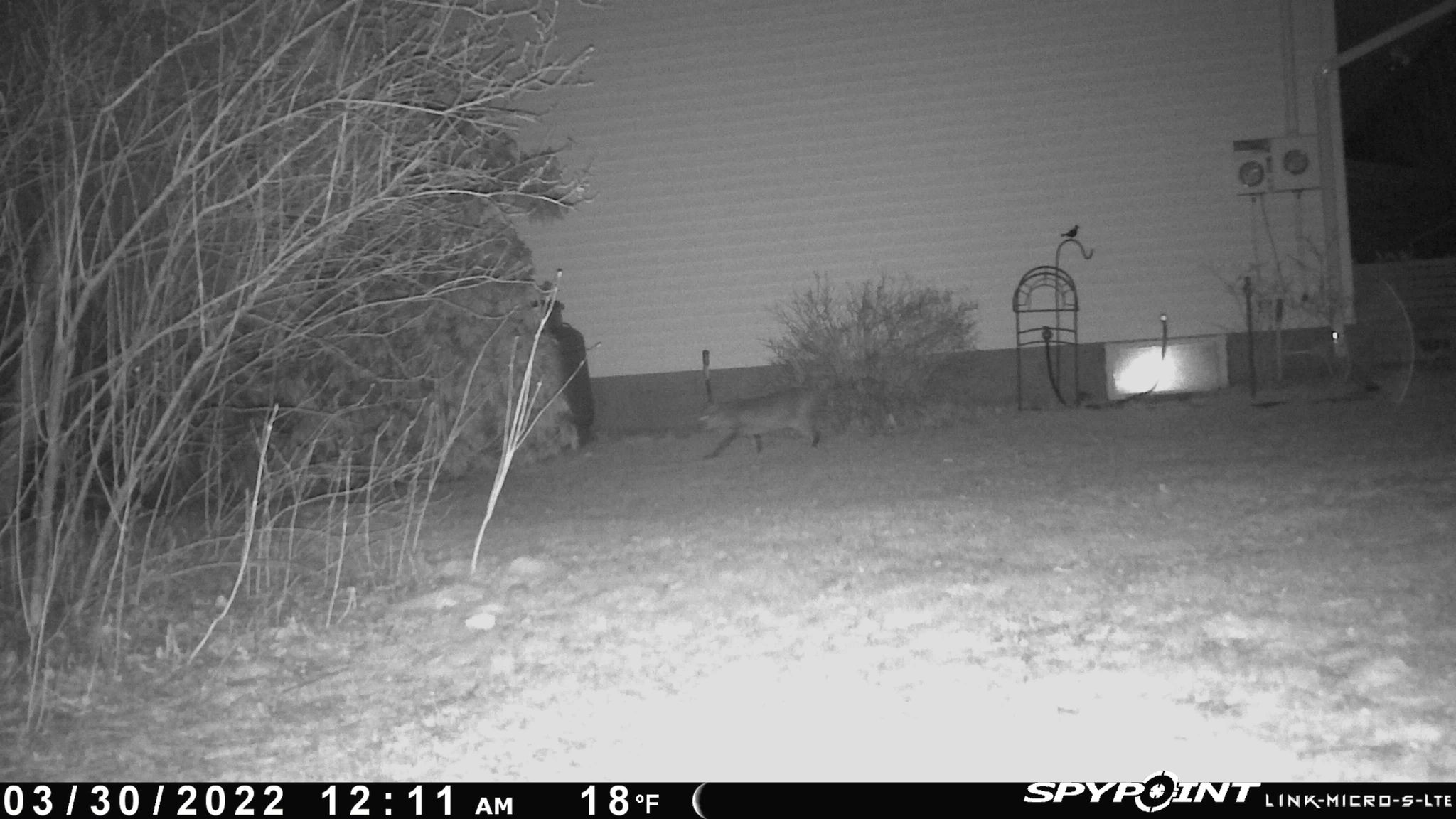
Perhaps it's time that I step out of the realm of Medford and check out something closer to home. There is currently quite the dustup over a certain gray fox wandering about in Saxtons River. It seems that residents are worried about the fox rambling about so close to houses during daylight hours. Some even suggesting that such behavior is odd for a fox and that it might in fact have rabies. One invested participant informed readers that they should stop composting for the time being as the fox was after their compost. I can imagine how she thought this as rodents do favor compost piles and fox favor eating rodents. 

All of this begs to question, what else do we get wrong? 


No, that's not a huge rat in my yard, it is an opossum. Feeling poorly for the Saxtons River fox, I attempted to defend its honor by explaining the tick / Lyme disease cycle and how mice are largely responsible for the transmission of bacterium Borrelia burgdorferi to ticks which in turn bite us causing Lyme disease. I know it's confusing because we call them deer ticks. Deer are poor transmitters however and they most often are just free transportation and a blood meal for the ticks. Mice account for around 90% of bacterium transmission rates to infected ticks. If you want to learn more about the tick/ Lyme connection and ways to reduce ticks in your yard, click on this link.  Just keep in mind that fox eat mice and mice infect ticks.

But doesn't it just make sense to learn to fall in love with passive tick eating opossums instead?


Admittedly, I too fell for the report that claimed that opossum eat thousands of ticks in a season. The trouble is, that research had yet to be peer reviewed prior to it exploding all over social media. Subsequent studies found no evidence supporting that opossum eat ticks. Love them anyway.

So it seems that we are back to reducing  mice populations and you might be surprised to learn what else eats mice and other small rodents.

(fluffy skunk bottom)

If nothing else is available racoons will eat mice too.


Crows, ravens, eagles, hawks, owls, blue herons and other birds eat mice.


Snakes, toads and frogs will eat mice too. Because so many animals eat small rodents and carrion, rat poison shouldn't be used outdoors where it can get into the food stream. Animals that consume a poisoned rodent are in danger of being poisoned themselves; and that includes our neighborhood cats.

 If the goal is to rid communities of rats (small rodents), then consider this: While it's true that too high of a concentration of rats potentially increases the spread of disease, it's also true that too few rats removes an important food source for wildlife.  Click on the link to read VT Small Mammal Atlas which states in part that, "So why aren't we over run with these rodents? Because they are a food source for most of the carnivores and omnivores living in our fields and forests. Without this food base our wildlife pyramid might collapse." The article also states that "of Vermont's 35 small mammal species, 13 (37%) are considered of highest conservation priority."

So while Medford and other communities may indeed be noticing an increase in the population of rats this spring, it's doubtful that their problems began with this spring's litters.  Their solution to this challenge is to figure out which part of it is the problem and which part the solution. In closing, I will share this one nature find. When I moved our winter birdfeeders away from our house, the mouse population inside our house dropped off.- Norma Manning


Saturday, March 27, 2021

Welcome Fox

 I know an old lady who swallowed a Fox, my that's outside of the box! She swallowed the fox to catch the mouse, I don't know why she swallowed the mouse, perhaps she'll die. I know an old lady who swallowed a coyote, how quixote! She swallowed the coyote to catch the fox. She swallowed the fox to catch the mouse. I don't know why she swallowed the mouse, perhaps she'll die. There was an old lady who swallowed a tick, ick!  

photograph by Alexander Andrews


When Ginny howls wolf at the window, you will find me lining myself up behind her getting low to look at the exact spot that caused her to howl. Luna positions herself at our side letting out an ear splitting racket. As anyone who walks past our house knows, Luna pulls the fire alarm at everything that moves. This spring she caused a five bike pile up when the lead biker stopped in his tracks upon hearing the hounds. Ginny yaps at passers bye, especially children on wheels, chipmunks and other dogs; but she reserves her howl for Toby the neighborhood cat, saxophones and other villains like fox.

So it was one morning all heck broke loose causing Wayne a near heart attack though he was down in the basement. With all of the hysterics going on behind the glass, the fox paused and looked directly at us. It was a miserable looking creature with barely a hair left on her tail. After a good look at us, she trotted across the road and down into the woods. I say she because mid March is the time of year when fox move in near our homes to have their pups which emerge in April.* They won't stay long, so keep an eye out. 

It's thought that the reason a she fox or vixen dens up under our porches, sheds and in our culverts is not to take advantage of our domestic pets; but rather to find a measure of safety from wildlife competitors and predators. The coyote is predominantly a resource competitor with the fox and they will eliminate fox and their kits when food resources are scarce.** Human created land pressure has decreased available territory and so coyotes and fox have learned to adapt to our environment. In truth, the fox is a solitary animal which would much prefer to be as far away from humans and coyotes as possible. 

There was a time in VT when the Gray Wolf was top Canid and the coyote was nowhere to be found. However, when the wolf became extinct in VT by the late 1800s due to habitat clearing and a twenty dollar a hide bounty to protect livestock, the coyote moved in.*** This story of habitat competitors reminds me of watching plovers as I walk along the ocean shore. When the wave rolls onto the shore, the birds retreat to dryer sand; but when the wave draws back into the ocean, the tiny birds rush towards the ocean searching for food. When we introduce people walking on the beach, the little birds get pushed further down the beach while they run to and from the ocean. 

So why have I taken liberties with Rose Bonne's classic about an old lady? Because when we humans begin to see predators in our backyards, we tend to find ways to drive them out and that may not be to our best advantage. While it's true that a sick fox or a few dead Rhode Island Reds might rightfully so raise alarm, what we should really be concerned about is having no fox at all. This is where the lowly tick comes in. We have all learned to fall in love with that homely tick eating Marsupial the Opossum because we see them as providing us with a no cost service. What if I were to tell you that the fox plays an important role in controlling Lyme Disease too?

"White-footed mice are the principal natural reservoirs for Lyme disease bacteria. Ticks that feed on mice are highly likely to become infected, making them capable of transmitting Lyme disease to people during their next blood meal"****

While it's true that Canids and other animals carry Borrelia, only about ten percent of ticks become infected with the bacteria from feeding on coyote, fox, deer, racoons, possums and birds. We associate Lyme infection with these animals because ticks hitch rides on them.  White footed mice infect ticks ninety percent of the time and a fox can eat five thousand mice a year.**** It makes sense that the fewer the mice the lower the infection and in fact research seems to supports it. In an area where there are less coyotes, there are more fox resulting in fewer mice and therefor fewer infected ticks.*****

 It turns out that biodiversity is a pretty good tool for preventing disease while eradication of a species creates more complications. It also turns out that given enough food resources, fox will cohabitate with coyote with little conflict and the same goes with fox and domestic animals.***** Speaking of other food sources, mice populations are also impacted by other factors besides fox predation, for example a variation in their own food availability as well as the fact that there are many more predators of mice than fox. 

As for those Rhode Island Reds, VT Fish and Wildlife recommends that electric fencing and proper feed management to reduce your losses. -Norma Manning

Resources:

*Discover Wildlife, A Year in the Life of an Urban fox

**Smithsonian Magazine, Foxes and Coyotes are Natural Enemies or are they?

***Stowe Reporter, Not Crying Wolf

****Cary Institute of Ecosystem Studies, Lyme Disease 

*****Cary Institute, Fox and coyote and ticks -oh my

Further reading:

Furbearer Conservation, A Tale of Two Reds: Old-world Versus New-world Red Fox


Friday, May 8, 2020

The Fox, the Farmer and the Hunter

Come fair season, I get to indulge in a strange fascination that I have with watching cattle judging.  Wayne doesn't share this interest that I picked up while taking classes in agriculture in the 80's; but if he tours the barns and watches a few showings while drinking a cola, he doesn't have to feel guilty checking out tractors or campers later on. I promise you,  I am going somewhere with this though we might circle around the proverbial barn a few times getting there.

The farmer's business is death. I didn't come up with that thought, I read it once in a Hoard's Dairyman that my friend slipped into my tote at work. Farmers raise crops to harvest and animals are the same, only they are called livestock. I had a conversation with my daughter Abby about how I was having difficulty watching the COVID-19 stories where they showed exotic animal meat markets in China. I was having particular difficulty with dogs in cages offered for sale. Abby who eats nothing with a face remarked, "you eat lamb don't you? What's the difference?" Abby is never one to take it easy on her mother.

I once watched a necropsy on a ewe at a sheep conference in Grafton. The Veterinarian put the sheep down on an outdoor table. With farmers and people like me crowded around as he began his examination while discussing what he was doing, why he was doing it and what he was finding. When he was pulling out the entrails and holding them up I noticed the crowed had thinned substantially. Before the Vet had finished,  I too had moved on to watch the Boarder Collies.  It was eighteen years later that I ended the suffering of my first dog at a Vet's office. During the procedure I had to walk away to collect myself while the doctor waited patiently for me to return. She knew that I needed to be there even when at the moment I could not.

This winter the Dummerston Conservation Commission hosted the Vermont state bear biologist. During her presentation she was queried on her feelings over using dogs to hunt bear. It was clear from the framing of the question and their tone, that the person asking was opposed to the practice. The biologist said that she knew hunters who used dogs and that many were good people who cared deeply about conservation.  She explained how hunters partnered with the biologists, using their bear dogs to help track the bears that were being studied. She reiterated that fishing and hunting license revenue also supported conservation.

In our neighborhood we have often been blessed with families of fox in the spring. I say blessed, but whomever owned those Rhode Island Reds I kept finding in my yard might have had a differing opinion. My neighbor who is a hunter developed a particular fondness for the family that denned up in the culvert under his driveway. Last summer we found turkey wings and feet, various parts of domestic birds and even a fawn's leg that was left for the kits to eat. This spring I had been keeping an eye out for their return but they didn't seem to be around. I had wondered if the farmer who owned those chickens had taken matters into their own hands. This morning my neighbor asked me if I had heard two gun shots yesterday. He said that another neighbor had called him about a sick fox in their yard. He said that the fox had lost all the hair on its tail and was encrusted around its face. They called the Warden who told them to put it down. He confessed that he was really upset at seeing the fox so sick and having to end its suffering. Here was this hunter who has many times shared his hunting stories with me, telling me about his grief over the loss of his fox family.  I understood exactly his grief and so when he changed the subject to that Robin who he fed worms to yesterday only to get pooped on, I wasn't at all surprised. - Norma Manning

Pigs on the lamb on Route 5

Canada Geese frozen in the ice at Lily pond with breast meat removed

Fawns leg left in my yard by the fox

Wayne's dinner in Maine

Rhode Island Red left in the road for her kits


Monday, February 17, 2020

Vernon Hatchery Winter Walk

We took the opportunity on a sunny Sunday in Feb. to check out the Vernon Hatchery,  but we weren't the first ones there. - Norma Manning