Sunday, July 24, 2022

Below The Dam

 With July temperatures creeping into the 90s, Vermonters head to the water. In Vernon that means any number of brooks, swimming holes, the town pool and the Connecticut river. After supper on Friday, Wayne and I headed to the beach below the dam. We found not the crowds that I had anticipated, but rather a peaceful scene with a few families swimming, a puppy learning about beach life and people fishing.  

Let's go for a walk as the sun begins to dip in the sky allowing for the cooling air to wash ashore atop rippling river waters. 


With the sunlight nearly done dancing on the flower petals, driftwood has been collected and a small beach fire is set.  It is time for us to call it a day. - Norma Manning

Friday, July 15, 2022

What's Steinbeck Got To Do With It?

I thought that I fell in love with John Steinbeck in high school and I felt all the more sophisticated for it. I began collecting books in elementary school but hadn't yet realized that is what I was doing: rocks, dirt from every state, absolutely everything animals and yes definitely books. Before Steinbeck, I read about wildlife, a certain country veterinarian, a redhaired girl named Anne, a family who lived on the prairie... but mostly I read about horses and dogs. I read adventures about horses and dogs, tragic tales about horses and dogs, children who owned exceptional horses and dogs, more importantly, I read encyclopedias about horses and dogs . Clearly with Steinbeck, I had turned a corner, even if the first novel that I ever read by him was The Red Pony.

"Nature always wins," this was the overriding statement  that I chose for an Expository Writing class assignment on  American author John Steinbeck. My professor came across as being dispirited in his written remarks on the last page of my essay by claiming that I had a, "superficial understanding of Steinbeck." Apparently it was structural injustice that John Steinbeck was writing about. Potayto - potahto, or so my nineteen year old self had reasoned. As I reflect back on all of this, I have come to recognize over my thirty nine years since, that nature isn't actually winning, Steinbeck had more to say, and a "superficial understanding" is just as valid of a place to begin learning as any. 

I often wonder, had a broader public awareness of Environmental Justice and Climate Justice existed in the early 80s, if my professor and I would have had a very different sort of exchange. It was after all, Steinbeck's symbolic use of  nature to support his theme of injustice, that drew me into the conversation.  Later on, I was exposed to storytellers like Betty Smith with A Tree Grows in Brooklyn (1943) and Jane Goodall's Reason For Hope (1999), who built upon that foundation laid down by dogs, horses and Steinbeck. 

In a day when the internet wasn't, and very few outlets were talking about injustices spurred by environmental conditions, it was already being explored by the foundations, observations and works of our storytellers. Even so, my daughter reminds me that it is time to turn yet another corner,. She believes that we have heard from those who are looking in, that it's time for us to pause our voices and to carefully listen to the voices of those who are living within structural injustices of society. I think that is wise advice given to a person who grew up blindly reciting, "and justice for all" at the start of each school day. 

John Steinbeck's The Grapes of Wrath is hardly front and center on reading lists anymore, and what could any of this have to do with Vernon VT Nature Finds? If I am to be truthful here, this essay is actually a collection of thoughts brought on by unexpectedly having to toss my book collection into a dumpster sitting in my driveway. It's the gutting of our home, the accumulation of 37 years of marriage, our kid's things along with the things handed down from our parents and grandparents all sitting in that dumpster. It's Wayne, in spite of the overflowing dumpsters, placing our recycle bins out by the road on collection day and all the while knowing that for us, all of this is only an inconvenience. We are going to recover. 

"...the most severe harms from climate change fall disproportionately upon underserved communities who are least able to prepare for, and recover from heat wave, poor air quality, flooding, and other impacts. EPA's analysis indicates that racial and ethnic minority communities are particularly vulnerable to the greatest impacts of climate change.."  Click here to read more on this EPA report

Furthermore, this essay is written for Vernon's youth in order to help them to understand that when some person or some group labels your collection of ideas as "superficial," that's just a starting point to a conversation. - Norma Manning

Conversation Starter for young and old alike:

We Are the World, Wikipedia

People of Color are on the Frontlines of the Climate Crises


Friday, July 1, 2022

Walking It Back


Wayne and I recently celebrated our 40th BFUHS class reunion. It was during the final preparations for  the Alumni Parade, that one of my classmates offered up  his Division 1 State Football Championship jacket for me to wear. Another classmate chimed in that it wasn't going to fit me, to which a third quickly informed them that they had "better walk that back". It was all in great fun as back in the day, my brother Charles' teammates used to rib us both that the wrong sibling was on the team as I had a few good inches on my brother. Though Charles and I were born in the same year, Charles was a year behind me in school. My little brother never misses an opportunity to celebrate with the Class of 82 and his State Championship buddies. As I often say to my friends when speaking about BF boys, "You can take the boy out of  BF; but you can't take BF out of the boy!" I suspect that's pretty much true about a lot of things.

For reasons that will hopefully become apparent, if you haven't yet read The $64 Tomato by William Alexander, then I'm recommending that you move it straight to the top of you summer reading list! 

The other day while I was sitting in my recliner drinking a morning cup of coffee, my attention was drawn to a rather large brown creature nosing up to the living room window. The critter being a mere two feet from where I sat, I slowly turned my eyes fully towards her. Living with two dogs, one of which being a mix of coonhounds, I learned long ago not to make any sudden movements or sounds lest (as my neighbors are well aware) the Krakens be released! Once our eyes fully met, the woodchuck realized her error, leapt from the planter and vanished into the Bee Balm.

Typically guests to my planters include, chipmunks, birds, frogs and toads...but mostly chipmunks.

It is with some foolish pride that I relay that a Biologist friend of mine informed me this spring, that we had done about all that we could do by way of transforming our one acre of land into a wildlife friendly environment. We aren't going to share this friend's observation with Wayne however, as I still have some ideas for wildlife that I'm working on. It would also seem that the wildlife have a few ideas of their own.


 On June 11th, I posted, "The Trouble With Solutions" in which I discussed the value of rats, mice, and other small food base rodents. I also discussed the importance of a balance that is maintained by the presence of predators. I have come to realize that things often look better on paper than they do in practice. And though I frequently relay to others a sentiment of; when you put out the welcome mat for wildlife, you had better be prepared for them to accept it, I am in practice, continually surprised by the  antics of wildlife. 


While I was approaching the Black Walnut tree on our lawn tractor, I successfully avoided a hole with a total dirt spray of 5'5".  The hole itself was 2 feet long x 1 foot wide x 19 inches deep. At the bottom of the hole was another hole which was 2" in diameter. This smaller hole seemed to change direction.


As previously noted, I was in fact not born yesterday; and yet as I examined the scene I did so with the premise that the woodchuck had made herself at home under the walnut tree in my front yard.  Most of my readers being quite a bit brighter than myself, have already solved this mystery; but I'm going to spell it out anyway. It wasn't until I was struggling to attach my game camera to the hydrangea in such a way as to capture the holes rightful owner, that it dawned on me that this was less of a story about homesteading and more of a story about predation. 

A few of the usual suspects came to mind:

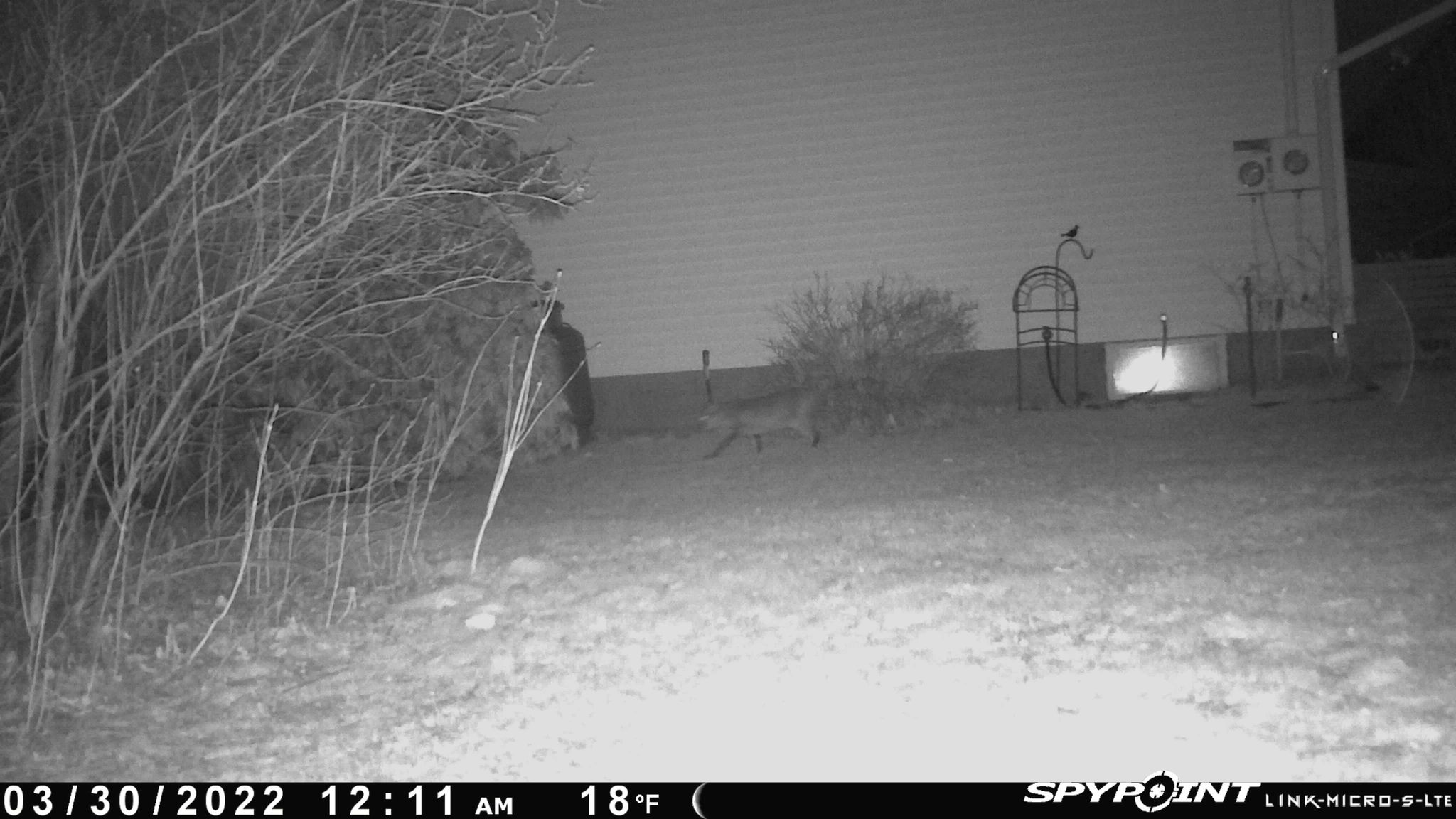
Could it have been the fox?

The skunk?
  
Perhaps it wasn't a wild animal  at all, maybe it was the stray pup?

Because I had no idea when the large hole was excavated, I would need a fair amount of circumstantial evidence to piece together the events. I was hoping that Agatha Christie had it right and it would return to the scene of the crime.  In any case, I think that I was finally on to something, whoever dug the hole was after the rodent who first called it home; and because there was a smaller hole at the bottom, the rodent had escaped it's fate.  


Paparazzi! 

  Chipmunk

I would like to mention here, that I set my game cam towards that hole on the morning of the June 27th and repositioned it each day. By the evening of June 30th I had managed to capture chipmunks and squirrels. 

With one last attempt to frame the culprit, on July 1st as I screened my pictures, I started to wonder why it was that I immediately turned my focus to who done it? Why hadn't I instead, ended the whole dang thing by just filling in the blasted hole? In the five days since I discovered the offensive hole, no other hole materialized, so was there really any problem to be solved?. Perhaps it was past time to move on;  after all, what was I really going to do if I found out who done it? 

Bunny just passing by

Racoon with its head in the hole


Although I hate to admit it, not everything can be blamed on the usual suspects (squirrels).  As much as a critter is going to do what a critter is going to do, and nobody will convince them otherwise; aren't we humans pretty much the same way? And sometimes that's what's worth getting a chuckle out of! - Norma Manning


Thursday, June 23, 2022

Set Timer For 15 Minutes

 "Would you like to begin your day with bird chirping sounds?" This was my listening devices response to my directive to set a timer for fifteen minutes. Why yes, I really would like to begin every day with actual birds chirping I thought to myself. Of course, I would never divulge such personal information to my listening device, that would be just weird. But truth be told, what hasn't been weird about this year? Two days into summer break and clearly I'm still struggling for clarity. 

I thought about writing a blog for Father's Day that would go something like this: 

Interesting right? It even appeared as if I had captured one of those children's happily ever after movie endings!

That is until my daughter commented, "Uh oh, baby skunks!" Also there is one pesky little complication to my story, daddy skunks aren't at all involved with raising their kits. 

Now as it is, I happen to like skunks; but Helen's comment reminded me that my neighbor had recently complained that an emboldened skunk had denned up under his shed. In fact, he said that the critter had actually peeked into the shed while my neighbor was working in there. What else could possibly go wrong with my picture perfect Father's Day "tail" I wondered? 


Oh just stop it!


And so with that squatting fox and my brother's comment of, "No decency" I lost my will to write a Father's Day post.

I chose instead to commence with a therapy of sorts that I call Angry Gardening. I loaded up my kid's old red wagon with two kinds of saws, a hand trowel, pruners and my push lawnmower then set out to set a few things right. 

 
The culmination of my searching for clarity through my Angry Gardening therapy, turned out to be a gaping hole in my hedge and a brush pile of shrub honeysuckle. I love shrub honeysuckle; I love how tall it is, I love how it seems to grow in any location, I love it's density, it's fragrant pink or white flowers and how every winter its bark is stripped by deer and rodents. But most of all, I love how birds and bunnies alike hang out underneath it. 


I always stand back and look at what I have done after an impulsive gardening adventure. I get that from my father. He used to silently stare at completed projects while drinking a diet cola. Perhaps we even shared the same thoughts of, "What in heaven's name have I just done?" 

The shrubs I left standing in this hedge are rhododendron and lilac. I transplanted this trio of shrubs years ago in part to screen my view from utilities.  And like a true family of teenagers; lilac prefers alkaline soil, rhododendron prefers slightly acidic while bush honeysuckle likes acidic to mildly alkaline soil. Somehow, in spite of my poor planning, they had all grown into healthy large shrubs. 


My first memory of invasive species is the one of my friend Kathy admonishing my frugality. I had decided that wildflower seeds were too costly and so began filling my pockets with seeds that I found on our walks. "How do you know they aren't invasive?" she scrutinized. 

 My father had little use for anything in the yard that wasn't fiscus. My mother's gardens were tolerated if they were fenced in a geometric shape to allow for easy mowing. Trees and or shrubs were permitted along perimeters and only if the mower could fit easily around them. All of our trees were lollipopped so that they could be mowed under. Of course, lawns were not for walking or playing on, that's what sidewalks and parks were for.  

When Kathy mentioned invasive plants, I genuinely had no idea and no reason to not continue spreading seeds; I was after all, being a progressive thinker in light of my family tree.


Never the less, it would be years before I found myself standing in a perennial garden in Westminster requesting native plants for a shady dry site. The owner abandoned his sale by forcing the question, "Native to what!" In so many words he further expressed that he didn't understand what was with all of the people wanting native plants. If it wasn't for his friendly barefoot employee guiding me away with a promise of what she thought to be a native, I might have lectured Wayne all the way home in the car. Thank goodness for teachers working second jobs on their days off! 

Papaveraceae

The short answer to all of this is, that non-native plants take up space where a more valuable plant to that ecosystem might otherwise exist to the mutual benefit of the communities within it. Invasive plants are non-native plants that readily outcompete, reproduce and escape beyond their native range. Invasive plants ultimately create a decline in the biodiversity upon which we all depend.  Oh, and of course this extends to wildlife as well. (p.s. striped skunks are native to VT)
  
I attempted to quote for my purposes, numerous statements from Chittenden County Forester Ethan Tapper's discussion of the issue in his paper, "What's Wrong With Invasive Plants?"   Each time I quoted Forester Tapper however, I felt that in isolation his words lost their contextual impact. I implore you to read his two page paper in its entirety by clicking here.

Vermont Invasives: Gallery of Terrestrial Plants, displays forty nine invasive land plants in VT. 
I have identified on my acre of land, eight invasive plants featured in this gallery. Only the barberry has been completely removed. Though it seems that I have plenty more opportunities in which to seek clarity, I think that next time, I will begin by opening up my window to listen for actual. real, live, native, chirping birds - Norma Manning


Furthermore: 

Eastern Wild Turkeys are dependent on a varied habitat consisting of hardwood and mixed forests. In the 1800s, Vermont's wild turkeys were pushed to extinction due to extensive clearing of these forests and the spread of agricultural lands. They were first reintroduced in 1969 and fortunately have made a tremendous comeback. They are now widespread throughout the state. -Vermont Fish and Wildlife Department; Eastern Wild Turkey

Controlling Invasive Plants Using the Cut-Stump Method - Click here for directions


Saturday, June 11, 2022

The Trouble With Solutions


This week Boston news ran a story about how Medford residents are frustrated with the large number of rats (the picture was of a mouse) inhabiting their hamlet. Trust me Medford, when I post that I feel your angst.


Knowing practically nothing about Medford, I took a guess and commented that Medford didn't so much as have a rat problem as they had a shortage of predators problem. Suggesting that Medford increase their number of snakes, fox, weasel, raptor and coyote earned me more than a few laughing emojis. 


I had to concede that one solution does not fit all scenarios; and oddly enough other people who read the Boston news also had their own ideas on how to solve the infestation. In fact, several suggested domestic cats, like this new to my yard cat for example. While I imagine that our beloved neighborhood cat Tobie is none to pleased about this fluffy orange cat checking out his turf, Tobie clearly is not handling all of my rodent woes on his own.  If I'm to be honest however, I also must include to the list of cat solution conflicts, that it's estimated that outdoor cats kill between 30 to 48 birds per cat per year. That's 1.3 to 4 billion birds a year! (The Cornell Lab, All About Birds). 


I wondered if perhaps the solution didn't require a larger cat, one that didn't focus on birds so much? As it turns out, bobcats eat both birds and small rodents and a lot of other things; but mostly they prefer to dine on hair and rabbits. 

(bobcat) 
Perhaps it's time that I step out of the realm of Medford and check out something closer to home. There is currently quite the dustup over a certain gray fox wandering about in Saxtons River. It seems that residents are worried about the fox rambling about so close to houses during daylight hours. Some even suggesting that such behavior is odd for a fox and that it might in fact have rabies. One invested participant informed readers that they should stop composting for the time being as the fox was after their compost. I can imagine how she thought this as rodents do favor compost piles and fox favor eating rodents. 

All of this begs to question, what else do we get wrong? 


No, that's not a huge rat in my yard, it is an opossum. Feeling poorly for the Saxtons River fox, I attempted to defend its honor by explaining the tick / Lyme disease cycle and how mice are largely responsible for the transmission of bacterium Borrelia burgdorferi to ticks which in turn bite us causing Lyme disease. I know it's confusing because we call them deer ticks. Deer are poor transmitters however and they most often are just free transportation and a blood meal for the ticks. Mice account for around 90% of bacterium transmission rates to infected ticks. If you want to learn more about the tick/ Lyme connection and ways to reduce ticks in your yard, click on this link.  Just keep in mind that fox eat mice and mice infect ticks.

But doesn't it just make sense to learn to fall in love with passive tick eating opossums instead?


Admittedly, I too fell for the report that claimed that opossum eat thousands of ticks in a season. The trouble is, that research had yet to be peer reviewed prior to it exploding all over social media. Subsequent studies found no evidence supporting that opossum eat ticks. Love them anyway.

So it seems that we are back to reducing  mice populations and you might be surprised to learn what else eats mice and other small rodents.

(fluffy skunk bottom)

If nothing else is available racoons will eat mice too.


Crows, ravens, eagles, hawks, owls, blue herons and other birds eat mice.


Snakes, toads and frogs will eat mice too. Because so many animals eat small rodents and carrion, rat poison shouldn't be used outdoors where it can get into the food stream. Animals that consume a poisoned rodent are in danger of being poisoned themselves; and that includes our neighborhood cats.

 If the goal is to rid communities of rats (small rodents), then consider this: While it's true that too high of a concentration of rats potentially increases the spread of disease, it's also true that too few rats removes an important food source for wildlife.  Click on the link to read VT Small Mammal Atlas which states in part that, "So why aren't we over run with these rodents? Because they are a food source for most of the carnivores and omnivores living in our fields and forests. Without this food base our wildlife pyramid might collapse." The article also states that "of Vermont's 35 small mammal species, 13 (37%) are considered of highest conservation priority."

So while Medford and other communities may indeed be noticing an increase in the population of rats this spring, it's doubtful that their problems began with this spring's litters.  Their solution to this challenge is to figure out which part of it is the problem and which part the solution. In closing, I will share this one nature find. When I moved our winter birdfeeders away from our house, the mouse population inside our house dropped off.- Norma Manning


Sunday, June 5, 2022

Mr. Phelps' Ice Shanty


Sometimes when you purchase something, it's more than the something that truly matters. Take Mr. Phelps' shanty for example, on that day I bought a story with a lesson attached and as you will soon find out, I did in fact buy a shed. Well, actually I bought a project.

I typically tell a version of this story to my students between academics and right at that time of year when growing includes finding out about generosity and gratitude. To be clear, I never set out to tell this story; but how many arguments about marbles, pencils and chairs need one experience before it just pops out? 

My grandfather was quite the fisherman, In fact, his brothers were all skilled at fishing. Each of his brothers were named Joseph which has nothing at all to do with my story; but is quite interesting nonetheless considering there were ten siblings five of which were boys. My grandfather was Joseph Maurice; but everyone called him Morris. 

As it so happened, in the 50s Morris bought a piece of land between his brother Joseph Marcell's and Joseph Lucien's in South Hero upon which he built by hand and tool a camp. By the time that I came along, Morris and Anna lived in that place on lake Champlain year round and that is where I myself learned how to icefish. 

Now owning a shanty was something of pride and something of necessity when winter winds could blow a rambunctious child clear across to the other side simply by raising a snow shovel as a sail while sitting on a sled. The five of us children along with whichever cousins were visiting, had to wait for our turn to sit next to the adults and stare down an ice fishing hole. I for some reason remember that Morris had a stove, perhaps a coal stove if I remember correctly; but (I never share this part with my students) Morris used to say he kept warm with Canadian Club Whisky. Oh, and Morris raised baitfish in his cellar which seemed quite magical to me as young child, These are only some of the memories that I have of ice fishing with my grandfather. 

But all of this was many years ago as Mrs. Manning is now well over fifty years old!

My sister lives in his house now; and she is even older than I.

Mr. Manning and I noticed while visiting, that Mr. Phelps who lives at Phelps' farm just up the road from my sister's was having a yard sale. At first we looked at his many tools and camping gear and then later on, we went back to make him an offer on his old gray shanty. I was so excited to have a shanty of my own, that I plum forgot to look closely at it inside and out or to even consider if I actually wanted one. 

That very next weekend, Mr. Manning drove back up with his trailer to bring the shanty home to Vernon. It was while loading it onto the trailer, that the skis used to glide it across the ice fell off and the eyebolts used to attach the rope for pulling it ripped out. I'm not sure that you are going to believe me when I tell you about this next part, but once that shanty arrived in my driveway, I called up our daughter Helen and offered it to her for free! I was quite surprised when she said, "no thank you," after all, it did have beige carpet covering its bench seats. 

Over the next couple of weeks, Mr. Manning replaced two walls, the roof, both skids, the eyebolts and the skis. Our daughter Abigail, who doesn't fish at all, decided to paint fish on the lids that cover the holes in the floor when no one is using them for fishing. For my part, I painted the shanty with leftover green paint from another project that I never quite started. 

It was after all of this and while I was adding the finishing touches to the shanty, that I paused to read Mr. Phelps' hand written sign that he had screwed to an inside wall.

"Please Leave it Like you find it" Even though his shanty stayed out on the ice for the entire ice fishing season, Mr. Phelps never once locked the door.  He had instead, used a dog leash clip and a cord to fasten the door closed against the cold winter wind. In this way,  Mr. Phelps shared his shanty with anyone wishing to use it. I imagine that people who came upon it on blustery days, thought of Mr. Phelps as very neighborly. 


I keep that sign posted in what is now my potting shed as a reminder of just that. -Norma Manning