Saturday, May 28, 2022

Perfectly Problematic Hike To The Headwaters


There are many important rules to remember when hiking in the backwoods; but none so more important as choosing a partner who is more attractive to insects than yourself. On this hike, Wayne came away with four ticks while I had none...mission accomplished. Other important information for this hike to the headwaters of Roaring Brook is to wear waterproof shoes and apply liberal quantities of a quality insect repellant. 

We parked at the Basin road trail head at the Vernon Municipal Forest and proceeded through the gate and up the town forest road towards the Roaring Brook Wildlife Management Area.  We continued straight (west) on the forest road, keeping the big swamp to our left and hiked past the "trail closed" signs and into RBWMA.

Note: the trail closed signs were posted by VAST and are posted to direct snowmobiles away from this area. Foot traffic is still permitted on this trail. The question is, do you like mud?

Looking at Wayne's On X image below, the Basin Road trailhead enters the picture on the lower right of the image. We first hiked up the right side of the image from the green section which marks the Vernon Town Forest past the white horizontal line that identifies the state owned lands of RBWMA. The Roaring Brook is shown as a darker solid blue line and tributaries are shown in broken blue lines in the same shade of darker blue. Our hike is shown by the light blue broken line.

The water in this area is positively teaming with life. 

Spring flowers have begun to arrive.

The Efts were so plentiful that it takes concerted effort to avoid stepping on them. I took two pictures to illustrate their color variations. Efts may be red, orange or a brownish color. After their second metamorphosis they are yellowish-green aquatic adults.


I never become tired of discovering variations in moss in the town forest and the RBMA


Is it just me, or does this mushroom growing on a living White Pine tree look like a face both upright and upside down?


I failed to mention that the reason we decided on this hike is because Claire and Gregg invited us to hike Taconic Ramble Mountain state park.  This is Vermont's newest state park and is listed as, "challenging terrain." Basically, we need to get some more miles in between now and then.


Eastern Mountain Laurel is a native evergreen shrub that blooms in late May to early June.  The town forest will be filled with white blossoms during this time. 


Today (May 15th) Hobblebush, a native Viburnum is in bloom. 


On one side of the trail there is little to no ground cover for wildlife.  


Directly on the opposite side of the trail, there is green. An old logging trail blockaded with logs may hold the reason why.


In the middle is mud. 


Some things never seem to improve. We hiked this muddy section of trail a few years ago and vehicles degrade this area still.


Some hikers don't mind the mud.


Mud and bugs aren't exactly Wayne's favorite trail conditions. He is a good sport however and so we slog through. When telling my mother about our hike she remarked, "Don't tell people to go there."


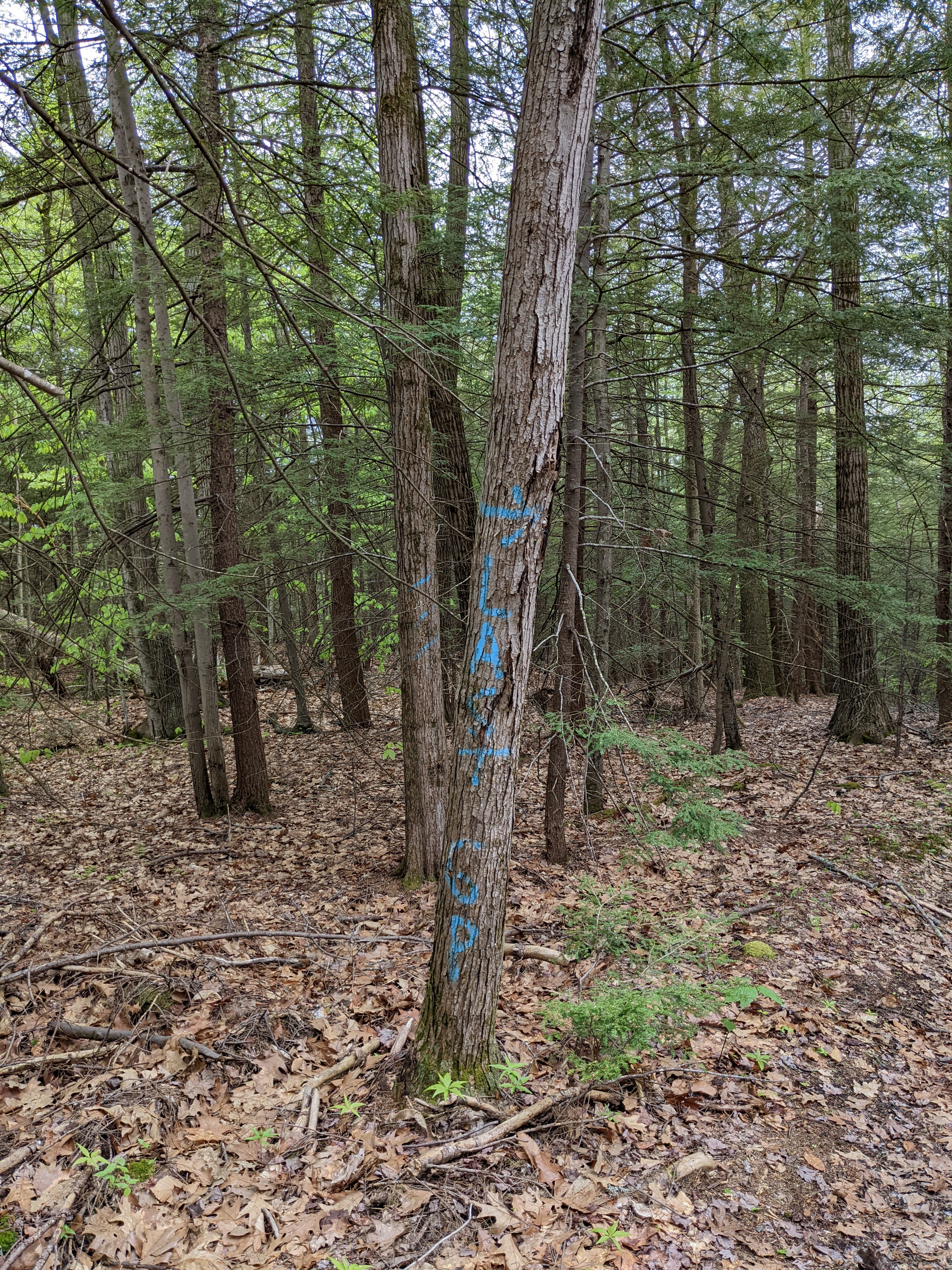
This tree marks the state land boundary.


Boulders have been laid across the trail to prevent motorized vehicles from entering state lands.


There is always a way.


I remember why we turned back years ago.


This area looks to be logged in striations (think tiger stripes).


Saplings take advantage of increased light.


I failed to notice the condition of the two trees behind this American Beech until I reviewed the picture. 


This boulder appears to be an erratic deposited by glaciers; but with so much logging activity it's also possible that it was brought here by trucks.


Finally dry trail ahead!


Signs of a working landscape are everywhere. 


There is a balance to be considered and achieved here. On the one hand logging increases brows for deer and the like. On the other hand, old growth is required habitat for wildlife such as the Piliated Woodpecker.


One constant, biting insects, exists here.


Something has been enjoying dining on or at this tree. My hunch is that it's a porcupine.


When searching for water, I suppose one should expect to find some; but why is it always in the middle of the trail?


Perhaps bring hip waders too.


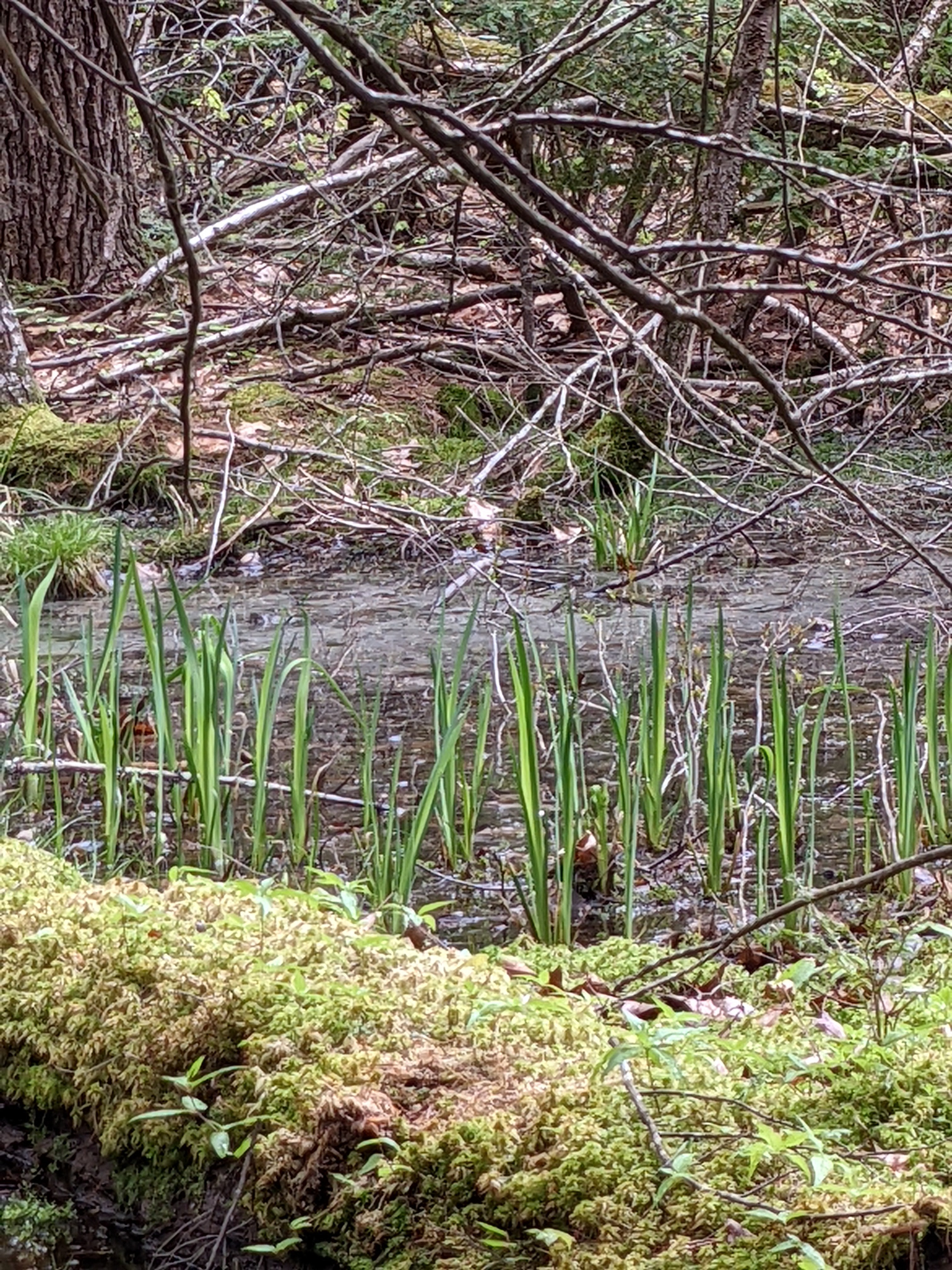
Once a friend expressed concern that the new sign at the Basin trailhead depicted cattails when in fact the town forest has none. I can't resist getting a little extra muddy to capture this picture of cattails in the RBWMA.


Just beyond the swamp is the surveyed boundary between state lands and the Kuhn Licia Divona parcel.


Even the bypasses are flooded.


There is a small open area which serves as a three way intersection. Here is what looks to be an old cellar hole, a VAST marker and the place where Wayne claims that the map shows the Roaring Brook headwaters.


The only issue being that the streambed is dry.


Can I interest you in a black cherry tree or unique tree partnerships instead?


It's ridiculous to be searching for water at this point in our hike.


Red blazes on the tree line tell us that we have reached the lower boundary.


Wayne's OnX map shows that just south of the RBWMA line we will cross the Roaring Brook.


A new VAST bridge has been built over the Roaring Brook in this location. On previous hikes Wayne and I waded through this area.


You are still getting a bath Ginny!


It's all uphill from here to the town forest and the Stateline Trail. Sometimes we aren't entirely sure if we have reached our goals. The map says yes so I suppose that's good enough. 
 

-Norma Manning


Friday, May 20, 2022

Man's Best Friend Has New Best Friends? By: Cooper and Hadley Deyo


This spring we had some special visitors at our house. Just 30 feet from our porch Mama Fox built her den. In fact, she built two dens. 

Mama Fox is a Red Fox. Female Red Fox are also called "Vixens. She is red, orange, white, black and has a long bushy tail. Mama Fox has visited us before. This is the third year in a row she has birthed her kits in our yard. This year she had seven of them.


Raising seven kits is a lot of work. Thankfully she has help from two other adult foxes. They all work together to bring back food to the den and keep a watchful eye on the kits.


The kits are are dark brown or black. The runt of the litter is our favorite. He is all black. We named him, "Wilbur". 


They like to playfight, wrestle, run and tumble. We mostly see them early in the morning and just before dark. 


We think Mama Fox likes our yard because it is a safe place for her family. 


Once the kits get older their color will change from brown and black to red and orange like Mama Fox. When that happens, we know they will be moving from our yard back to the woods.


Our dog Maple will be sad to see them go. He thinks he has ten new best friends. The fox family is not sure being friends with Maple is a good idea!

Thank you Cooper and Hadley for your interesting and educational fox report! Nature Finds encourages community members and visitors alike to become guest bloggers. Please email your Vernon, VT experiences with nature and your knowledge of  our natural communities to eaglestailvt@gmail.com 

Saturday, May 14, 2022

Not The Bee I Was Looking For, or Maybe It Was?


It's no secret that many of Vermont's pollinators are becoming harder to find. The University of Vermont's Gund Institute for Environment published "Study Reveals Striking Decline of Vermont's Bumble Bees" four years ago with findings that, "four of Vermont's 17 bumble bees species appear to have gone extinct." This Spring, I noticed that Vermont Fish and Wildlife updated their language on their website with, "Pollinators in Peril" where they in part describe the issue as, "Vermont recently added three species of bumble bee to its threatened and endangered species list." 

So When Wayne and I joined in greening up Vernon on Mother's Day weekend, I hadn't exactly planned on writing about how Wayne picking up a cast off empty bottle of booze might be the spark that Vernon required to motivate us to protect pollinators. But it was right there in plain sight, listed under ingredients for Evan Williams Honey Bourbon, "Natural Honey. It's All Flavor - No Sting." How could this not be a catalyst for change? As they say in Place Based Education, meet the students where they are at! 

 I do realize that there is an important difference in commodity with regards to the Bumble and the Honey Bee. Additionally, domesticated honeybees are not native to the US, and they are in competition with our native bees. But it appears that honeybee numbers are being impacted by some of the same forces that our native bees are. Why does any of this matter? The USGS states that, Honey bees increase our nation's crop values each year by more than 15 billion dollars." and the USDA states that, "More than 100 US grown crops rely on pollinators." If more motivation is needed than that, I offer you this:

 No honeybees = No natural honey flavored bourbon!


 Commitment towards restoring our environment comes in many forms. I encourage you to begin here. 


As a coordinator of Green Up Day in Vernon, Hannah among other responsibilities, helps resident volunteers choose a stretch of Vernon to clean up. Wayne chose Lily Pond while I was visiting with a friend who was interested in a project going in on West Rd. Hannah reminded us that Vernon wasn't going to clean itself!


Lily Pond is still at flood stage, but there were still plenty of interesting finds. I've decided to spare you photographs of the toilet paper (gross) and I will warn you that I am posting carrion in this edition. Below are Ring Neck Pheasant feathers, an interesting find as Ring Neck Pheasants are not found in VT or NH. 


38.6% of all litter is made of plastic. 2020 National Litter Study Summary Report 

There is twice as much litter from alcoholic beverages than non alcoholic. (NLSSR). I found a plastic beverage container that was mistaken for food. Plastic obstructs wildlife's stomachs and can cause ruptures and starvation. National Wildlife Federation, A Plague of Plastics In case you believe that glass is better, Paul Miller once informed me that glass bottles mess up farm equipment pretty good.

Wayne and I pick up around Lily Pond often. Cans, bottles and paper are a constant problem. Only about 35% of Vermont's waste is recycled, composted or reused. Vermont's Universal Recycling Law

As a Class Two wetland, Lily Pond has a 50ft buffer zone where mowing, removal of wood, and other alterations are restricted. This buffer is in place to protect rare plants and wildlife there. I found this skunk within the 50ft buffer under bramble.


 This appeared to be what was left of winter clothing.


Canada Goose feathers were also in this area. It's a federal offense to take a migratory bird out of season, that is unless you happen to be a coyote or other predator. These feathers may be from the fall hunt and are possibly are only now visible after the snow melted. 


Of course with spring, there are also signs of new life.


We couldn't reach the area beyond the parking lot as it is flooded, so we walked along the waters edge heading northwest.


Sometimes things like this barbed wire fencing are installed with a useful purpose only to be abandoned in place later on. We did not have the tools with us to remove this hazard.


How could I resist stopping to enjoy the view? The town of Vernon owns the access road, the parking area and the island at Lily Pond. We didn't pick up on the island this time. I am hopeful that during nesting season, people will resist disturbing birds on the island.


.6% of litter along roadways and waterways is office paper and mail. (NLSR). If school is a kid's office, than the chances of my finding someone's schoolwork at Lily Pond is fairly remote. Some estimates on  litter claim that up to 90% of litter is accidental litter.  How wonderful that I found such a fine example of student work! This student's teacher wrote, "So proud of you! This is really great work!" 


We decided to comb the access road and a short distance to the left and to the right of it on Pond rd. One volunteer started at the rec by herself and amazingly worked her way up to where we were. 


Some things defy explanation. With twenty one categories of plastic identified by the NLSR, 17.7% of litter is listed as "other plastic." 


Wayne removes a piece of sheet metal from the north shore.


Insulation and Styrofoam was on the shore and floating in the pond.


Wayne and I used sticks to coax the litter towards us. We couldn't remove it all.


In total, we removed two bags full of litter from  Lily Pond plus some larger pieces that we couldn't fit into the bags.


Our actions, be they intentional or unintentional have very real consequences to those things that we value.


Things like bourbon that is naturally flavored with honey and the conviction that all of Vernon's inhabitants have the right to enjoy a clean and safe environment. - Norma Manning